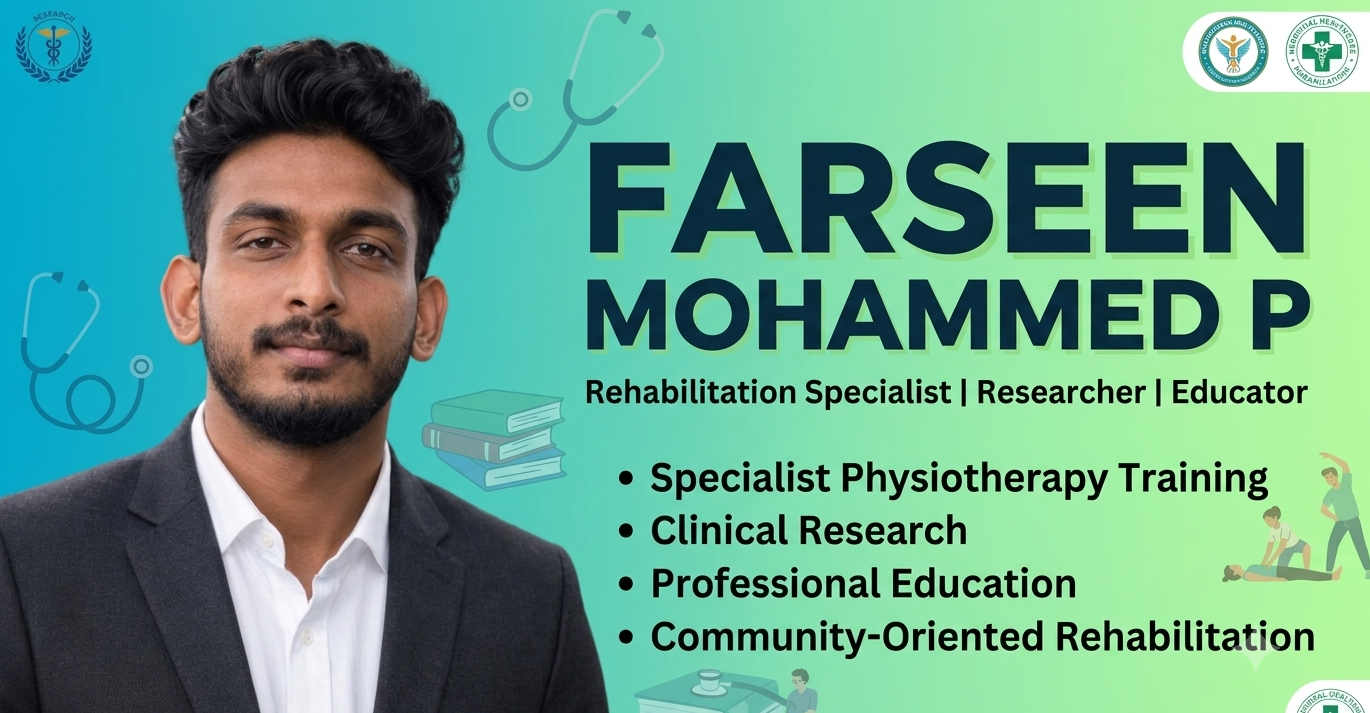
Mangaluru, Karnataka / Malappuram, Kerala: The role of physiotherapy continues to expand beyond traditional clinical practice, with research, evidence appraisal and scientific communication becoming increasingly important parts of professional development. Farseen Mohammed P, a specialist physiotherapist in neurosciences and clinical researcher, has been developing his professional career along this broader path.
With academic training in physiotherapy and neurosciences, clinical exposure across neurological and other rehabilitation settings, and an expanding research portfolio, Farseen has developed interests that connect patient care with scientific inquiry.
A Foundation in Physiotherapy
Farseen began his professional education with a Bachelor of Physiotherapy (BPT) from the Co-operative Institute of Health Sciences, Thalassery, affiliated with Kerala University of Health Sciences.
His undergraduate clinical training provided exposure to different hospital environments and rehabilitation settings across South India.
This foundation was followed by postgraduate education in neurosciences at Yenepoya Physiotherapy College, Yenepoya (Deemed to be University), Mangaluru.
Specialization in Neurosciences
Farseen completed his Master of Physiotherapy (MPT) in Neurosciences, with specialization in neurophysiotherapy and neurorehabilitation.
During his postgraduate clinical training, he gained exposure to neurological rehabilitation involving conditions such as stroke, Parkinson’s disease, traumatic brain injury, Guillain–Barré syndrome and spinal cord disorders.
His clinical training included rehabilitation approaches such as Neurodevelopmental Treatment, Motor Relearning Programme and task-oriented training.
This combination of postgraduate education and clinical exposure helped shape his interest in neurological rehabilitation and clinical research.
Research as Part of Professional Development
Research has become a significant component of Farseen’s professional profile.
His postgraduate dissertation examined eccentric versus concentric strengthening and functional mobility in subacute stroke patients.
The project provided experience in clinical intervention research and contributed to his continuing interest in therapeutic exercise and stroke rehabilitation.
He later extended this area of interest through systematic review research concerning eccentric strengthening interventions following stroke.
Developing Skills in Evidence Synthesis
Farseen’s research portfolio includes systematic reviews, scoping reviews and evidence synthesis.
These methodologies are relevant to modern healthcare research because they allow researchers to organize and critically examine available scientific literature around specific clinical questions.
His professional development has included formal training in systematic review and meta-analysis. In August 2026, he participated in a five-day international-level hands-on workshop focused on these research methods.
Published Work in Parkinson’s Disease
Farseen’s research activities have also resulted in published academic work.
He contributed to the 2026 scoping review titled “Timing of Dopaminergic Medication Relative to Physiotherapy Delivery in Adults with Parkinson’s Disease: A Scoping Review.”
The paper was published in the International Journal of Drug Delivery Technology, with Farseen Mohammed P serving as the second author and corresponding author.
The study reflects his interest in the relationship between medication timing and physiotherapy delivery in Parkinson’s disease rehabilitation.
Scientific Communication
Research is not limited to conducting studies; communicating findings is another important aspect of academic work.
Farseen has presented research at professional physiotherapy events, including Mangalore PhysioCon 2026.
At the conference, he presented his postgraduate research on eccentric versus concentric strengthening and functional mobility in subacute stroke patients.
He also presented a systematic review on eccentric strengthening interventions in stroke rehabilitation at SYNERGOS 2026.
His presentation at SYNERGOS received the First Prize in the Postgraduate Oral Paper Presentation category.
Broadening the Research Portfolio
While neurological rehabilitation remains a major focus, Farseen’s research interests are not restricted to a single condition.
His ongoing academic interests include:
- Stroke rehabilitation
- Parkinson’s disease rehabilitation
- Therapeutic exercise
- Evidence-based physiotherapy
- Clinical intervention research
- Exercise-based cardiac rehabilitation
- Metabolic and functional health
- Neurorehabilitation
His ongoing systematic and scoping reviews demonstrate an interest in investigating rehabilitation questions through structured research methods.
Additional Education in Nutrition
Farseen has also developed an academic interest in nutrition.
He completed a Post Graduate Diploma in Nutrition in 2025 through British Learning, United Kingdom.
The qualification complements his physiotherapy background and contributes to his broader interest in health, exercise and rehabilitation.
Continuing Professional Education
Farseen’s professional development has included several courses, workshops and academic activities.
His training includes Good Clinical Practice, stroke management, Neurodevelopmental Treatment, Motor Relearning Programme, health science research and publication, systematic review methodology and other physiotherapy-related continuing education.
This continued learning reflects an approach in which professional development extends beyond the completion of formal academic qualifications.
Academic and Professional Participation
Farseen has also contributed to academic activities within the physiotherapy education environment.
He served as an organizing member of the Scientific Committee for Mangalore PhysioCon 2026.
He was also involved with an Institution’s Innovation Council awareness workshop at Yenepoya Physiotherapy College focused on entrepreneurship and innovation as a career opportunity.
In September 2026, he served as a resource person for a CME session for nursing professionals at St. Joseph’s Mission Hospital, Anchal.
Connecting Clinical Practice and Research
The combination of clinical training and research is an important feature of Farseen Mohammed P’s professional development.
His clinical experience provides exposure to real-world rehabilitation challenges, while his research activities allow him to investigate specific questions through scientific methods.
His work in stroke rehabilitation, Parkinson’s disease, therapeutic exercise and evidence synthesis demonstrates this connection between clinical practice and academic inquiry.
A Developing Professional Profile
Farseen Mohammed P’s career represents an evolving pathway in physiotherapy that combines specialization, clinical training, research and continuing education.
From his undergraduate physiotherapy education to postgraduate specialization in neurosciences, clinical training, research presentations and published academic work, his professional development has increasingly incorporated research alongside clinical knowledge.
His continuing work in neurorehabilitation and evidence-based physiotherapy positions research as an important component of his ongoing professional journey.